March 11, 2008

Welcome to A Grain of Salt, a blog (mostly) about food and all things related

Over the years, I have realized to my great joy that I am, in fact, a foodie. There, I said it. There is no shame in it. When you begin to rhapsodize about the crunchiness of pig's ears or the bitterness of fried neem leaves, you might as well 'fess up. I have also realized, to my greater joy, that most of my closest friends are foodies. And so when one the closest friend of them all, brother really, and a successful professional and blogger to boot, asked me to write a food blog with him it seemed, it was one of those forehead-slapping 'duh!' moments.

And then laziness took over and we let the thought stew for a goodly bit. But here we are at last, and not a moment too late I say. The blog will be driven, at least initially, by rearset, whom you've already met and me, Kaultilya.

But WTF will you two write about, you ask. Hmm, let's see... share a recipe, or talk about technique, or diss a restaurant, or rave about a beer (or ten) or confess our man crush on Anthony Bourdain or protest the objectification of women using the Hooter girls as a case
study – I don't know, it will be pretty free form.

So welcome again. And remember to Take Life with A Grain of Salt

October 15, 2007

King's beer: I'm lovin' it

Kings Beer 3A very dear person just returned from Goa, bearing the sweetest of all gifts from that lush land... King's Beer. As I noted in this post, King's is one of the nicest beers I've ever tasted. Kautilya and I, were in Goa on a college trip, sometime in 1995 or so. We left our classmates to go have a gander at this island thing. As luck would have it, he and I arrived at the ferry literally minutes after the one we wanted to catch had pushed off, headed for its umpteenth trip across the lazy Mandovi. With not much to do, we found a run-down shack near the jetty and ordered a beer. He only had local brew – Kings. I am happy to state the forty minutes (or was it an hour) were spent in a happy state, tasting a really, really good beer, enjoying very good company and great scenery in lazy, lovely old Goa.

Of late, though, King's has become really hard to find. This person, evidently, spent a fair while searching for my five bottles worth (heck, I even love the shape of it, now echoed by the almost equally elusive Kingfisher Stubby).

Well, I'd like to thank her for taking the time to look for it. Oh, and I just wanted to let you guys know that I'm going home to five super-chilled bottles of the stuff. Yippee!


Original post

October 12, 2007

Haywards Black: I like it

Haywards Black PintsWikipedia says stouts and porters are dark beers, made with roasted malts or barleys. As would be the case with anything that's so old (1677!), it now has varieties and flavours.

SAB Miller, the chaps who brew Haywards 5K & 2K, Royal Challenge, Knock Out and Castle Lager (international brands include Miller, Peroni Nastro Azzure (Rossi's ex-sponsor) and Pilsner Urquell (quite nice, The Wife purchased some for me from Prague, not so long ago) recently launched Haywards Black, which is India's first stout beer.

The taste is a bit strange to start out with. Especially if you're beer-lover and beer-novice rolled into one. So unlike my friend Kautilya, I haven't been intimate with old Guinness so far. Please, please hold those collective groans, I'm working on that. Anyway, there's a strange taste I found hard to identify, but after reading through SABMiller's site, I think yes, it is that hint of caramel. The beer is just a tiny bit more viscous than normal beer and hence, tends to sit a bit heavy. It's no Guinness class meal yet, but you will notice the extra weight at the end of the pint. There is some extra alcohol, but again, it's not like the extra pint is going to knock the steadiness out of your legs or anything. On the whole, I like the beer a lot. That's why my fridge is now equally divided between HBs and Buds (Yes, I like the Indian Bud a lot too.)

Original post

August 10, 2007

Red Box, Bandra: Good food... iffy music

A few friends and I went to Red Box on Waterfield Road in Bandra for a bite one night. Just wanted to let you guys know that it's quite nice. We had a Squid Marengo starter (bacon and squid combo) which turned out to be delicious. As did The Wife's Lemon Thyme Chicken and my spare ribs. They serve Indian Bud too. It's a cheery, bright and inevitable noisy place with the oddest music. I couldn't escape the feeling that I was having dinner in a discotheque. Which should give you an idea of the volume and selection being played at the establishment. That said, I plan to return soon and give the menu another going over.

Original post

August 07, 2007

Budweiser in India

Budweiser Indian Pint

The first time I had Bud(weiser) I was at Delhi's TGIF and it sucked. Big Time. It tasted more or less like diluted water and I was left wondering at what Bud Light would be like – as in would I be able to taste it at all? So when a colleague told me that Bud was in India, I was wondering if it had made Anheuser-Busch wiser or not? Well, it has. I've just downed my fifth (I think) pint of Bud in the last four days, and I think I like it. I still don't think it topples my favourites (in order) – Kalyani Black Label, London Pilsner, Royal Challenge and Kingfisher – off their respective pedestals, but it is nice. It has a nice flavour, tastes like beer should and yes, I'm going to be drinking some more soon. Other faves? Corona (minus lime), Heineken (original German import only), Carlsberg, Stella (you can call her by her first name if you know her well enough) and Modelo Negro Especial (strange but true).

No, I haven't had Chillingtons, Guinness and other stalwart brands yet... but there's always tomorrow, right?

Original post

Shwarma: try this one

The Wife and I were heading home when she spotted a doner kebab maker at Hotel Sanman. [I don't know if the phone number in the link is the right one... but it sounds right] Having pulled over after the Shivaji Park petrol pump, I walked back to the man and asked what the damage would be like. He said, 'Fifty bucks. But you wont regret it.' So I ordered and watched in amazement as our man loaded a lavish amount of sizzling chicken into the nicely warm pita bread, with an appropriate slathering of hummus added in. Whoa! When we bit into the shwarma...
best effing one I have had since the ones at Arabian Nights in Priya, Delhi. And those are more fond memory than an actual taste. And it is gigantic too! You gotta try it...

Original post


Update: Since this post, the chap at Sanman has evidently been fired. Sigh.

July 14, 2007

Book Review: Heat, by Bill Buford

A friend of mine, who works in New York, purchased a copy of Bill Buford's book, Heat, for me recently. We were out walking the Manhattan streets, and had just walked into Strand, which advertises its 18 miles of books, before continuing to the Titanic memorial thingy and then to Pier 17 (we were going to end up more or less walking all the way up about halfway into Central Park... but didn't know it yet). Anyway, a food lover beyond compare, the other book he purchased was A Cook's Tour, by Anthony Bourdain, and more on that book in another post.

Heat, turned out to be a surprisingly good read. Well, coming from Kautilya, I wouldn't expect anything less. But what I mean is that instead of being a foodie-oriented great read, the book is almost an action-adventure located in a busy restaurant kitchen. There's blood, heat, tension, pressure and good grub, just a little bit more than the average thriller provides. Buford was a Fiction Editor at the NYTimes before he quit and embarked on the journey that is Heat.

It all started with Mario Batali, a genious cook and Buford's inspiration, and his restaurant Babbo (at which I ate, thanks to Kautilya; post coming), which drove Buford into this rather strange journey. Buford offers a very colourful, action-packed read. You should try it.

Original post

May 23, 2007

Pop Tate's Powai Review

I went there last night en famille to grab some grub. Given how good the food at Juhu Pop Tate's is, I was expecting a stellar meal, slow service, a slight wait for the table and a noisy, boisterous ambience... nothing like it. Tables were empty (you'll see why in a minute), service was prompt (though the waiter was like totally clueless), and meal was crap. The Wife and I tried to remember when was the last time we had a meal this bad. The question stumped us. My squid was as thick as a stack of coins, and about as edible. The chicken she had was pliable like rubber, and tasted roughly the same (do not ask how I know that). We also ordered some Arrabiata – a six year old given some tomatoes would have made it better. Basically, a giant, unwavering, totally disgusted thumbs down. We were so unhappy about the meal that we refused to accept any offered discounts, paid the amount in full and vowed never to return. You've been warned.

Original post

March 20, 2007

"Soul in Yo Bowl"

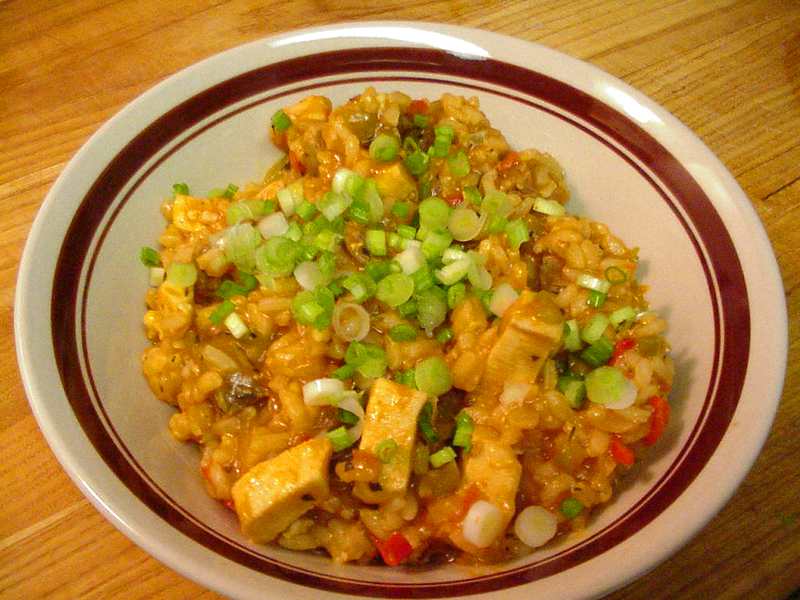
I make a good Jambalaya. I know this because most of the friends who have eaten it have lived to tell the tale. Some have even returned for seconds. And responding to a groundswell of popular demand, and for the greater common good, I feel that it is time that I should share my recipe for a Jambalaya. Vox Populi; Vox Dei and all that sort of thing, don't you know.


Ok, so the popular demand consisted of just one person but if you saw this populus, you'd know that she was all Dei.


Anyway, Jambalaya...


Jambalaya is a Cajun-Creole dish similar, in some ways to a Spanish paella or the Indian pulao (as opposed to the biryani). It originated in the swamps and badlands of Louisiana and according to
Wikipedia, the Jambalaya dates back to at least 1872. Jambalaya can be made with beef, pork, chicken, duck, shrimp, oysters, crayfish, sausage, or any combination thereof or indeed from any other meat as well. If you want to throw in some 'gator in your Jambalaya, go right ahead! I make mine with a combination of chicken, Andouille sausage, Chorizo and shrimp.

But we are getting ahead of ourselves. You have to start at the very beginning, which as Maria von Trapp assures us, is a very good place to start.


And in the beginning, there is the
trinity - equal parts onion, celery and bell peppers, chopped into a fine dice (about a half-cup each). The traditional trinity calls for green bell peppers but I find that just a tad too bitter and use red bell peppers instead (which also adds to the color of the dish, of course). I also throw in a few Jalapeño and/or Serrano peppers to add a little kick, but that is completely a matter of taste. The trinity should be sautéed in a dutch oven or any deep heavy pan , till the onions are transparent but not brown (deep so it can accommodate the rice and the meats without overflowing and heavy so that it retains heat. Do not use a non-stick pan, the reason for which will become clear in a minute). I prefer to use a combination of rendered bacon (pork fat rules!) and vegetable oil as the cooking medium but in these heart healthy times, use whatever oil you're comfortable with - vegetable, canola, peanut, olive; any one will do with two exceptions - extra virgin olive oil and mustard oil - because they have powerful aromas that will overwhelm the dish.

Season aggressively with crushed black pepper, cayenne pepper and Creole seasoning. If you are up to making your own Creole seasoning, here is a great basic recipe, but one can also buy this stuff pre-mixed and some of it is actually edible!

To the sautéing trinity, add the chicken and the sausages, each cut to about half-inch cubes/ slices/ dice - whatever floats your boat really. They should just be the approximate same size. It helps to use just one cut of chicken for e.g breasts (what can I say - I am a breast man!). Figure on using one chicken breast for two people. Season again with the Creole seasoning and sauté on medium heat till the chicken is browned evenly, some of the fat has rendered off the sausages and there is a good bit of 'frond' - the brown sticky bits at the bottom of the pan. The frond is critical to develop the brown color of the Jambalaya and to intensify the flavor; it is virtually impossible to develop a good frond in a non-stick pan. Enameled cast-iron is best, stainless steel is also ok, even hard anodized cookware will work in a pinch.


When the chicken has browned, add the rice (figure about a third to a half-cup per person - long grain rice works best, parboiled rice is fine) and move it around till the grains become sort of translucent. Add a couple of cloves of crushed garlic, move it around till it becomes fragrant and immediately add the cooking liquid for the rice (it happens fast in a hot pan - 30-45 secs - so watch out otherwise the garlic will burn). I like chicken stock but if you prefer fish/vegetable/ beef stock, that's fine. You can use water if you absolutely must but, be warned, it will dilute the flavors of the Jambalaya. You will need more liquid than if you were just cooking rice, so depending upon the type of rice grains you chose, you will need 2-2.5 times liquid. Use the liquid to also de-glaze the pot - scraping around the bottom to release all the frond and color and flavor contained therein.


Cook the rice as you normally would and about five minutes before the rice is done, add the shrimps (about a half-cup per) and some diced scallions. Be careful not to overcook the shrimp - when they turn pink they are done. Adjust seasonings while the Jambalaya is still liquidy and when the rice is done, so is the Jambalaya.


Eat. Enjoy.


Original post

February 13, 2007

February 08, 2007

The Art of the Omelette

In my Pantheon of superstar foods, the omelette has pride of place in the front row. It can be street food in India, an elegant supper at a French bistro, a hearty lunch in Spain and stuffed to overflowing at an American brunch. It can be eaten for breakfast, lunch or dinner and when you need something to soak up the excesses of a night on the town, the omelette can hang right in there with the fried chicken and the cold pizza.

According to the
Larousse Gastronomique (Robuchon, J., et al (ed), 2001, Clarkson Potter, New York, P.808), "the word [omelette] comes from the French "lamelle" (thin strip) because of its flat shape; previously it was known as alumelle and then alumette, and finally amelette." (So the Indian pronunciation is actually pretty close to the French original!) The French have been making omelettes since the 16th century and the pinnacle of their painstaking effort is the classic recipe known as L'Omelette aux Champignons - Omelette stuffed with Mushrooms.

Making a French omelette is a lot like making tea or making rice. It is very easy to make but very difficult to make well. And just like tea or rice, when an omelette is good it is sublime, when it’s bad, there are few worse abominations on the face of the planet.


I know because I had the misfortune of eating a particularly bad version a couple of days ago, which is what prompted this post. Here are a few critical things to keep in mind when making an omelette. Follow these simple rules of thumb and you will have French bistro quality omelettes - guaranteed.


First, the stuffing. If the omelette is to have a stuffing, make sure you cook it
before you make the omelette. The residual heat of the omelette will reheat the stuffing but if the omelette gets cold while you're making the stuffing, it's all over. For a mushroom stuffing, stick to the middle of the road - you don't want white button mushrooms which are pretty flavorless and get soggy but you don't want shitakes either which will overwhelm the flavor of the eggs. Creminis, in my experience, work best - they will stand up to the eggs with just enough earthy flavors to compliment them. Salt the mushrooms while they are sautéing to draw out the water - you don't want that moisture running out when the stuffing is in the omelette!

Now for the main event -
L'Omelette!
  • Make sure that the eggs are at room temperature. Eggs straight out of the fridge tend to coagulate and don't mix as well when beaten, leading to dense and heavy omelettes.
  • Speaking of beating, the eggs should get a thorough one. Beat the eggs for at least 10 minutes. Don't be shy (or lazy) - I've gone so far as to use a mixer on the eggs but if you have any experience in hand mixing a latte, you can do this with a fork. The more air you can incorporate into the eggs the lighter and fluffier they will be.
  • This one is optional, but instead of just adding milk, try adding a teaspoon or so of cream to the proceedings too (for three eggs. Adjust the amount of cream for fewer or more eggs). Also add a teaspoon or so or water.
  • This one is not optional - use butter as a cooking medium! Not vegetable oil, not olive oil (not even the good stuff) - butter. Say it with me - butter!
  • Cook the omelette slow and low. Well, ok - medium to medium low. But you don't want to crank the heat 'cause that will only burn the outside before the omelette cooks through.
  • This leads us to – non-stick skillets. This is one of the very few recipes where I would recommend using a non-stick skillet over a regular one. Since you don't need to fire up the afterburners, the safety issues with non-stick pans can be overlooked. You can slide the omelette off more easily, the calorie counters can use a little less butter and since non-stick pans generally don't sear very well, you get a nice even golden color on the omelette.
  • And finally, do not cook the omelette all the way through in the pan. Residual cooking will continue after you take the eggs off the heat and you must account for this. If the eggs are completely cooked in the pan, the by the time they get to the table, they will be overdone, dry and stringy. The trick is to take the skillet off the heat when the edges of the omelette have set but the center is still slightly moist and runny. Fold in the stuffing, thus giving that a little time to warm up too. Plate.
Now, there's a good egg, what!

Original post